Wednesday, March 23, 2016

Notes 3.20

Royal Palace, Brussels
The Mirror Room with its marble and copper walls was intended to evoke the atmosphere of the Congo. The ceiling is covered with the shiny green wing cases of 1.4 million Thai jewel beetles.


Neuroscience, it is claimed, has revealed that our brains operate with a dual system for moral decision-making. In 2001, Joshua Greene, a philosophy graduate student, teamed up with the neuroscientist Jonathan Cohen to analyze fMRIs of people’s brains as they responded to hypothetical moral dilemmas. They inferred from looking at neural activity in different regions that moral judgment involved two distinct psychological processes. One of the processes, a fast and intuitive one, took place by and large in areas of the brain associated with emotional processing, such as the medial prefrontal cortex and the amygdala. The other process, which was slow and rational, took place by and large in regions associated with cognitive processing, such as the dorsolateral prefrontal cortex and the parietal lobe.

Greene interpreted these results in the light of an unverifiable and unfalsifiable story about evolutionary psychology. Since primitive human beings encountered up-close dangers or threats of personal violence, their brains, he speculated, evolved fast and focused responses for dealing with such perils. The impersonal violence that threatens humans in more sophisticated societies does not trigger the same kind of affective response, so it allows for slower, more cognitive processes of moral deliberation that weigh the relevant consequences of actions. Greene inferred from this that the slower mechanisms we see in the brain are a later development and are superior because morality is properly concerned with impersonal values—for example, justice—to which personal harms and goals such as family loyalty should be irrelevant. He has taken this to be a vindication of a specific, consequentialist philosophical theory of morality: utilitarianism.
But as the philosopher Selim Berker has pointed out in his important paper “The Normative Insignificance of Neuroscience,” the claim here is that personal factors are morally irrelevant, so the neural and psychological processes that track such factors in each person cannot be relied on to support moral propositions or guide moral decisions. Greene’s controversial philosophical claim is simply presupposed; it is in no way motivated by the findings of science. An understanding of the neural correlates of reasoning can tell us nothing about whether the outcome of this reasoning is justified. It is not the neuroscience but rather our considered moral judgments that do all the evaluative work in telling us which mental processes we should trust and which we should not.all of those I discuss here are making claims about which kinds of moral judgments are good or bad by assessing which are adaptive or maladaptive in relation to a norm of social cooperation. They are thereby relying on an implicit philosophical theory of morality, albeit a much less exacting one than utilitarianism. Rather than adhering to the moral view that we should maximize “utility”—or satisfaction of wants—they are adopting the more minimal, Hobbesian view that our first priority should be to avoid conflict. This minimalist moral worldview is, again, simply presupposed; it is not defended through argument and cannot be substantiated simply by an appeal to scientific facts. And its implications are not altogether appealing.


in his 2011 book The Better Angels of Our Nature: Why Violence Has Declined.
In that extremely influential work Pinker argues that our rational, deliberative modes of evaluation should take precedence over powerful, affective intuitions. But by “rationality” he means specifically “the interchangeability of perspectives and the opportunity the world provides for positive-sum games,” rather than any higher-order philosophical theory. He allows that empathy has played a part in promoting altruism, that “humanitarian reforms are driven in part by an enhanced sensitivity to the experiences of living things and a genuine desire to relieve their suffering.” But nevertheless our “ultimate goal should be policies and norms that become second nature and render empathy unnecessary.”


...So in addition to questioning whether psychological research can vindicate moral norms, we also have to ask whether the minimal moral norm of cooperation employed by psychologists is sufficient to provide them with a reliable moral compass.

Monday, March 21, 2016

 So the paradox is, that it's much easier to imagine the end of all life on earth than a much more modest radical change in capitalism. - Zizek!

Descartes, Biography, Ch 2, Desmonde Clarke

1596-1650

"My objective never extended beyond an attempt to reform my own thoughts and to build on a foundation that was entirely my own" DM

Illustration of Rene Descartes (1596-1650), French mathematician and philosopher, during a dramatic incident in a boat. Descartes was crossing the River Elbe in Germany, probably in 1621. The German boatmen believed that he was a rich, French merchant and began audibly talking in their own language about killing him and stealing his supposed money. Descartes understood German and drew his sword; despite being a small man, he forced the boatmen to continue the journey. Science Photo Library

From Discourse on Method RE travel etc: "I learned not to believe anything too firmly about which I had been convinced by example and custom alone. Thus I gradually freed from many errors that can cloud our natural light and makes us less capable of hearing reason. But once I had spent some years studying in this way the great book of the world and trying to acquire some experience, I decided one day to study also within myself, and to use all the powers of my mind to choose the paths that I should follow. I was much more successful in this...than if I had never left either my country or my books" 41 [philosophy against custom and the Book...he reverts to himself, but what is left when we leave the armchair behind with local opinions and the book? where do we go to clarify our 'natural light'?]
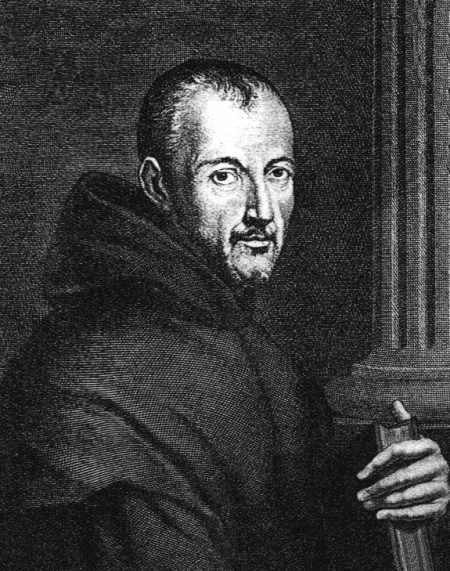
Mersenne (1588-1648)

Pythagoras 570-495 B.C.E.

RE Music, Harmony, Pythagoras: "Philosophers since the time of Pythagoras had dreamed of discovering a natural harmony in the universe that would be expressed in mathematical terms. This suggested that, if one could crack the cosmological code and then express it in musical notation, one could use music to help bring the human soul into harmony with the universe...One sees remnants of that tradition in some of Descartes' contemporaries, such as Keplar's Harmony of the World (1619) and MErsenne's Universal Harmony (1636)" 43

Apotheosis of St. Thomas Aquinas - Francisco de Zurbaran
Apotheosis of St Thomas Acquinas. Francisco de Zurbaran, 1631

RE Scholastic Philosophy: "For some decades scholastic philosophy had seemd to many scholars to be 'dead, barren, outworn, and irrelevant.' The response to this widespread intellectual effeteness emerged in two forms, religious and philosophical. The religious response was the familiar challenge of the Reformation to return to a form of Christianity that was closer to the Gospel, and to unshackle the church from the debilitating scholasticism that it had adopted as its official language. / THe philosophical response was an equally radical search for new categories and new sciences that would put its practitioners in touch with a wide range of natural forces and, through them, with the ultimate source of these occult powers, God." 54

RE Arcanum, mysticism: "He wrote to Mersenne, 20 November 1629: 'As soon as I even see the word arcanum [secret] in a proposition, I begin to think poorly of it" 58

Descartes, Biography, Ch 1., Clarke


1596-1650

Intro, Ch1
"a conflict of cultures between a desiccated, obsolete scholasticism and the emerging scientific revolution. Descartes major contribution to the history of ideas was made in articulating that conflict...addressed many of the inherent weaknesses of traditional philosophy" 5
"...philosophical innovator who continued to exploit many of the scholastic concepts that his own work rendered problematic"


Frontispiece of a 1720 edition of the Institutio Oratoria, showing Quintilan teaching rhetoric
Marcus Fabius Quintilianus (c. 35 – c. 100 CE) was a Roman rhetorician from Hispania, widely referred to in medieval schools of rhetoric and in Renaissance writing.

RE Quintillian: "the objective of any rhetorical presentation was to convince one's hearers. Hence the need, according to Q, for clarity and distinctness - two concepts that were to figure subsequently key features of the Cartesian account of evidence" 18
RE Quintillian, features of rhetoric esp important for lawyers: "the prime essential for stirring the emotions of others is, in my opinion, first to feel the emotions in oneself...an arg must be based on certainty; for it is obviously impossible to prove what is doubtful by what is no less doubtful" 18

RE Jesuit teaching:"...avoid 'new opinions' and not to introduce any opinion that 'does not have suitable authority' or is 'opposed to axioms of learned men or the general beliefs of scholars" 21

General Structure of a school day at La Fleche College c. 1610

5:00/5:30 A.M.      Rise, pray, and repeat lessons to one's prefect
7:30/8:00 A.M.      Formal classes
10:00 A.M.            Attend Mass
10:45 A.M.            Lunch in the refectory
11:30 A.M.            Recreation
12:00 A.M.            Private study, and repetition of lessons with one's prefect
2:00-5:00 P.M.       Formal classes
6:00 P.M.               Dinner, and recreation
7:00 P.M.               General repetition of lessons
9:00 P.M.               Visit to the church and prayer before retiring

File:Averroes. Line engraving by D. Cunego, 1785, after A. R. Men Wellcome V0000252.jpg
Line engraving by D. Cunego, 1785, 
EG non-Christian int's of Aristotle: Averroes (1126, spain): "understood Aristotle as proposing that there was a single world soul in which all thinking beings participate" "

Pomponazzi
Pomponazzi: "if the human soul is the 'form' that defines the nature of human beings, then the soul ceases to exist when the individual dies...P did not argue that the human soul cannot possibly be immortal. He only defended the more modest position that, as far as human reason or philosophy can take us, there is no basis for believing that each person has an immortal soul, although it might be accepted on faith as part of the church's teaching."

St Ignatius of Loyola (1491-1556) Founder of the Jesuits.jpg
St Ignatius of Loyala, Rubens 
RE Spiritual Exercises of St. Ignatius (Wiki): The Spiritual Exercises of Ignatius of Loyola (Latin original: Exercitia spiritualia) (composed 1522–1524) are a set of Christian meditationsprayers and mental exercises, written by Saint Ignatius of Loyola, a 16th-century Spanish priest, theologian, and founder of the Society of Jesus (Jesuits). Divided into four thematic "weeks" of variable length, it is designed to be carried out over a period of 28 to 30 days.[1] They were composed with the intention of helping the retreatant to discern Jesus in his life, leading him to a personal commitment to follow him.

RE SE of SI: "relied very much on the imagination to represent scenes from the life of christ, to reflect on the Christian's life as a journey toward God; and they systematically invoked the senses as a starting point for acquiring an appreciation or understanding of spiritual realities" 28

Thursday, March 10, 2016

Notes 3.9.16

In the past decade or two, as Silicon Valley has emerged as the most dynamic sector of the economy, our ideas about aesthetic fulfillment have undergone a subtle transformation. Our models of creativity are no longer struggling loners like painters or novelists. They aren’t media figures, like pop stars or movie stars. They’re not performers of any kind, for the most part—definitely not dancers, stage actors or classical musicians. More than anything, they’re skillful managers and team builders—entrepreneurs like Steve Jobs, architects like Zaha Hadid, chefs like Redzepi. Their mode of work—sociable, engaged, attentive to design, profitable—is immensely appealing, especially to those stuck alone at a desk or computer console.


Hence the attention to soil, grass, mushrooms and wood. In its refusal of culture in the name of nature, Redzepi’s cooking reminds me not so much of anything Nordic, but of Teutonic philosophy. In “The Origin of the Work of Art,” Martin Heidegger describes a pair of old peasant shoes vibrating with “the silent call of the earth, its quiet gift of the ripening grain and its unexplained self-refusal in the fallow desolation of the wintry field.” The earth represents, to Heidegger, a state of being before humans and before language. It’s a kind of philosophic no-place at the other end of an experiential abyss. The difficulty of thinking our way into it is the reason it’s so hard to answer the question of what it’s like to be a bat—or a toad or a rock or a clump of grass. Poets fascinated by the nonhuman realm, like Seamus Heaney and Francis Ponge, try to put this “silent call” into words. In his own peculiar way, Redzepi is attempting to do the same thing, only instead of trying to give it voice, he wants to put it on a plate.


So this is Redzepi’s wish: to put a piece of ground in front of a diner and have him figure it out. And once you got over your dismay at being served moss on a plate, maybe you would. His cooking is an attempt to go beyond the world of language and culture and into the world of pure things. And like any real artist, Redzepi articulates desires we didn’t even know we had—not for nutritive powders or engineered foams, but for contact with another way of being. To taste the essence of rocks and trees, to creep through the forest like a snail, to sleep in the earth like onions, with our feet in the air.


 Noma, Jacob Mikanowski ThePointMag


Intellectuals, no less than politicians, respond to crises based on what they think they learned from earlier ones. It is difficult to see what is genuinely new in an emergency, harder still to admit ignorance in the face of it. Our instinct is to assume that the unforeseen confirms our picture of the world rather than the necessity of altering it. The temptation to settle old scores is particularly hard to resist.


Charb and the radical French republicans keep restaging the eighteenth- and nineteenth-century battles against the Catholic Church, which was a powerful religious institution wielding authority. There is no such institution in Islam, just a community of communities of believers bound together in a collective relationship with God


Manent’s analysis rests on the distinction, inherited from Montesquieu, between a society’s explicit formal legal order (les lois) and the implicit mores, habits, and beliefs that bind it together (les moeurs). This distinction, he believes, helps us to understand why the integration of Muslims in Europe has proved so difficult. Secular Europeans today think largely in terms of the principle of individual rights and no longer accept the authority of social moeurs. They would prefer to forget their continuing debt to Christian cultural assumptions, such as the autonomy of individuals and the moral priority of inner experience.
According to Manent, Muslims, on the other hand, assume the priority of communal morality over individual liberty, an assumption most societies in most times and places have also made throughout history. He therefore finds it understandable that Muslims see modern ideas of freedom as just another set of cultural moeurs, and feel condescended to by Westerners delivering lectures on human rights.
Taking these two incompatible perspectives as given, Manent thinks that the practical challenge European countries face today is to find ways to maintain the independence of law while also recognizing the moeurs that Muslims consider legitimate.


 in Manent’s view, Muslims understand something secular Europe doesn’t: strong moeurs binding a community trump abstract political principles held by unconnected individuals. (This was also the fundamental thesis of Houellebecq’s Submission.)


In Kepel’s view it was these events that crystalized a new consciousness among the third political generation of young French Muslims, who have become susceptible to the allure of fundamentalism in a way previous generations never were. Though in language, education, and pop culture they are highly assimilated, they are disengaged from domestic politics and identify increasingly with the conditions, real and imagined, of Muslims worldwide. A demonstration against the National Front will not bring them into the streets but one in opposition to Israeli bombing of Gaza will. They see themselves less as Muslims of France than as part of a global religious proletariat suffering from Islamophobia and colonialism.


over the past decade the Internet nursed the development of both an online right-wing “fachosphere,” expressing nationalist anger, and a mirror-image Muslim “jihadosphere,” websites that are astonishingly similar, down to the expressions of vicious hatred of Jews.
- How the French Face Terror, Mark Zilla

Tuesday, March 8, 2016

Photography


NOTES 3.8.16

 “Humans believe themselves free of fear when there is no longer anything unknown. This has determined the path of demythologization … . Enlightenment is mythical fear radicalized” - Adorno, DE


what they find really mythical in both myth and enlightenment is the thought that fundamental change is impossible. Such resistance to change characterizes both ancient myths of fate and modern devotion to the facts...
 ...A dialectical enlightenment of enlightenment “discloses each image as script. It teaches us to read from [the image's] features the admission of falseness which cancels its power and hands it over to truth”


Adorno regards authentic works of (modern) art as social monads. The unavoidable tensions within them express unavoidable conflicts within the larger sociohistorical process from which they arise and to which they belong.
SEP entry, "Adorno"


Viewers dip in and out of “The Clock,” Christian Marclay

But what happens next is that you are thrown — or rather eased — into another movie. Film proceeds by means of phantom continuity. The imperceptible gaps between the frames and the smooth cuts between shots fool the eye and the mind into perceiving a steady flow of action. This is enabled by a syntax that after more than a century, we absorb intuitively: A man walks through a door and we will see him on the other side of it.
In “The Clock,” though, it is a different man and a different house, a different movie. The overlapping sound creates a new illusion: that all movies are contiguous, part of a boundaryless second reality that reflects our own even as it obeys its own spectral, magical logic. -A.O. Scott, "The Clock" You Always the Time, NYT


“a long list of things that quicken the heart.”
“Part of what I loved about poetry was how the distinction between fiction and nonfiction didn’t obtain how the correspondence between text and world was less important than the intensities of the poem itself.” Narrator, 10:04


"I find it very nearly impossible to read a contemporary novel that presents itself unselfconsciously as a novel, since it's not clear to me how such a book could convey what it feels like to be alive right now." - David Shields


“I’m scared of contemporary fiction because it often seems to me like the author is trying to write something that could be easily adapted into a movie.” Fie on intense plot, she says. She wants intense language and intellection." - Annie Nugent Baker


There really are some people for whom life is a daily struggle. I’m pretty sure that the point and meaning of life is to ensure that as few as possible have to exist in that way. And that’s only possible if we stop assuming that we all do. - Justin Evans, The Lonely Intellectual, ThePointMag

Monday, March 7, 2016

NOTES 3.7.16

After the 1960s, the battle for personal liberty seemed to be mostly won. The achievements have been great – and yet, in the 21st century, we find ourselves less sure than ever about how far our freedom includes the right to offend or transgress, and how much of it we want to compromise in return for convenience, entertainment or an illusion of total security. Freedom may become one of the great enigmas of our time, and the existentialists’ radical take on it may be worth a second look.
-


Wells on the set of Chimes at Midnight
But his story begins in May 1937, when Welles met Hemingway at a screening of Joris Ivens’s The Spanish Earth. Welles was to narrate Hemingway’s commentary, decided to edit it a little, and Hemingway was offended. He accused Welles of being gay, Welles hammed up the role appropriately, and the two men swung at each other with a couple of chairs. They ended up laughing and drinking and becoming friends. “Welles told this tale time and again,” Karp says, and by 1958 he had in mind a film based on the incident. He was calling it The Sacred Beasts, and it involved bullfighting. Was it about Hemingway or about Welles himself? “It’s about both of us,” he said.
- Looking for Citizen Welles, Wood, NYRB


Shields is obsessed with the big problems that obsessed me when I was in college: death, meaninglessness, loneliness, metaphysical uncertainty. But Adorno argued that such big problems are just ways of (at best) ignoring actual problems or (at worst) contributing to them. When people discuss “the human condition” or “human nature,” Adorno argued, they tend to mistake currently “existing” empirical facts for “existence” as a whole. (It’s as if I, a resident of Los Angeles, said that the human condition involves being a Lakers fan.) Whereas the real problems, the hard problems, are not part of some inescapable condition. They’re historically specific injustices, and they’re our fault.


He is like a man who builds a prison around himself and then complains about the guards.
 -  Justin Evans, The lonely Intellectual, The Point Mag

Thursday, March 3, 2016

NOTES 3.3.16

Justice and Divine Vengeance Pursuing Crime,
Pierre-Paul Prud'hon 1805 - 1806


There were partisan polemics in the months after the Charlie Hebdo attacks but they were not about security. One focused on the national school curriculum, a fetish object the French rub whenever they feel unsafe. To the question “Who lost French Muslim youth?” the instinctive response of many was the educational system, and they pointed to everything from the declining number of hours students study French history to the deemphasis on Greek and Latin. Articles were even written on the epidemic of orthographic mistakes on student exams as a sign of civilizational decline"


Jean Meslier, "If God is incomprehensible to man, it would seem rational never to think of Him at all" Testament pub 1729

There is in fact a multitude of ways to practice philosophy, but out of this multitude, the dominant historiography picks one tradition among others and makes it the truth of philosophy: that is to say the idealist, spiritualist lineage compatible with the Judeo-Christian world view. From that point on, anything that crosses this partial – in both senses of the word – view of things finds itself dismissed. This applies to nearly all non-Western philosophies, Oriental wisdom in particular, but also sensualist, empirical, materialist, nominalist, hedonistic currents and everything that can be put under the heading of "anti-Platonic philosophy". Philosophy that comes down from the heavens is the kind that – from Plato to Levinas by way of Kant and Christianity – needs a world behind the scenes to understand, explain and justify this world. The other line of force rises from the earth because it is satisfied with the given world, which is already so much
- Michael Onfrey


Intellectuals and politicians have been arguing about the causes of le malaise français for decades, calling on the French to change their policies and thinking, on the assumption that their destiny was in their hands. That assumption no longer holds. The globalization of economic activity, including the American financial crisis and the transfer of decision-making to the opaque institutions of the European Union, has been eroding the sense of national self-determination for some time. And now the refugee crisis and international jihadist networks are eroding confidence that the state, which the French expect to be strong, can protect its citizens.


jihadism has nothing to do with Muslim institutions and little to do with Muslim life. He noted that the large majority of French jihadists are second-generation Muslims who, unlike their parents, speak French, grew up with little to no contact with mosques or Muslim organizations, and before their conversions drank, took drugs, and had girlfriends. They are estranged from their parents and don’t know where to fit in. Or they are recent converts, largely from rural areas and many from divorced families...jihadism is a nihilistic generational revolt, not a religiously inspired utopianism.
-NYRB Can France be Saved

Jules Bastien-Lepage, Joan of Arc

Wednesday, March 2, 2016

NOTES 3.2.16

Making of Anomalisa, Kaufman, 2015


Millicent Weems: What was once before you - an exciting, mysterious future - is now behind you. Lived; understood; disappointing. You realize you are not special. You have struggled into existence, and are now slipping silently out of it. This is everyone's experience. Every single one. The specifics hardly matter. Everyone's everyone. So you are Adele, Hazel, Claire, Olive. You are Ellen. All her meager sadnesses are yours; all her loneliness; the gray, straw-like hair; her red raw hands. It's yours. It is time for you to understand this.
Millicent Weems: Walk.
Millicent Weems: As the people who adore you stop adoring you; as they die; as they move on; as you shed them; as you shed your beauty; your youth; as the world forgets you; as you recognize your transience; as you begin to lose your characteristics one by one; as you learn there is no-one watching you, and there never was, you think only about driving - not coming from any place; not arriving any place. Just driving, counting off time. Now you are here, at 7:43. Now you are here, at 7:44. Now you are...
Millicent Weems: Gone.


Arthur Schopenhauer; drawing by Wilhelm Busch
The gift of genius is nothing but…the ability…to discard entirely our own personality for a time, in order to remain pure knowing subject, the clear eye of the world.
“Submission” is a novel of ideas, the ideas being that France and Europe are in decline, and that Roman Catholicism is dying, if not already dead, but Islam is alive; in the book’s view, since the Cold War, no one in France — besides Muslims — has found any larger political ideals to believe in.
In “Submission” and his other novels, Mr. Houellebecq’s protagonists are numb men who long for feeling, nonbelievers who crave belief. There’s graphic, joyless sex. Most women are lovers or mothers. Often they die, providing the desultory main character an opportunity to experience true feeling, until the feeling passes. In a scathing review of “Submission” in Le Monde, the novelist Christine Angot wrote of her offense at the author’s depictions of women and their “vaginal dryness.”
Put bluntly, the women in his novels are in bed — and then they die. “Yes,” Mr. Houellebecq said, pausing slightly for comic effect, “like all of us.” Was this his view of women, or that of his characters? “It’s the way my characters see women,” said Mr. Houellebecq, who is twice divorced. “I don’t get too involved.”
Then he glided into provocation. “Prostitution is a good idea,” he said. For whom? “Everyone.” But isn’t it a form of exploitation of women? “All work is exploitation,” he answered. Isn’t that a bit too easy? “But it’s true,” he said. So does he himself frequent prostitutes? “That’s none of your business.” Surely the police escort must complicate things? “No, no,” he said. Prostitution, he added, “is one of the foundations of Western civilization — it’s a corrective to monogamy.”
- Michel Houellebecq, Casually Provocative, NYTIMES OCT2015


Each of Malick’s films presents a conversation or debate between what he suggests is the dominant Western worldview and a competing perspective. Malick follows Heidegger in identifying the Western worldview with the Enlightenment drive to systematize and conquer nature. According to this point of view, man demonstrates his significance through technical and scientific mastery—and on an individual level, he falls into insignificance when he fails to win the acclaim of other men. The competing perspective in Malick’s films is the artistic or filmic perspective, of which the paragon example is Malick’s camera itself. Malick’s goal as a filmmaker is to educate the human eye to see like his camera does. If our habits of vision are characterized by ambition, skepticism and greed, Malick inspires us with the virtues of patience, appreciation and awe. He offers not new facts or arguments but persuasive images of the world as if filtered through such virtues. Alongside these images he presents a character in each film who expresses, with increasing confidence and dignity, the point of view epitomized by the camera. These characters conceive of a power or location they can only gesture toward with words: “Sometimes I wished I could fall asleep and be taken off to some magical land, but this never happened,” says Holly in Badlands. “I’ve seen another world—sometimes I think it was just my imagination,” says Witt in The Thin Red Line. -
-ThePointMag

Tuesday, March 1, 2016

NOTES 3.1.16


"If, as Sombart contended, the reality and expectation of rising economic conditions – and the sense that this was a nation that rewarded work – was the key to socialism’s absence, then the reality and expectation of declining economic conditions, and the sense that this is a nation that rewards only the rich, is the key to socialism’s – or more precisely, socialists’ – surprising presence. That’s why, in 2016, there are socialists – by the millions – in America." - Guardian Feb292016


"That’s how I experience life, as an ocean of quotidian existence in which meaning is diffuse and difficult to grasp, and then comes death with its unprecedented concentration of meaning, or else love or birth."
"Building a fiction room requires either great strength or great ignorance. To understand what I mean by a fiction room, one need only read Tolstoy’s War and Peace. I have read it twice and have been sucked inside on both occasions, as happens only with the greatest of novels – one invests greater and more numerous emotions in them than in real life itself, occasionally becoming aware that one is yearning for the rooms the novel opens, even for the characters it portrays. The many scene shifts, from the manors to the cities, from the ballrooms to the battlefields, and the changing viewpoints, characters developing on the basis of their various experiences and therefore continually facing each other in new ways, winding in and out of each other’s lives, without ever standing alone, yet also without knowing this to be so..."

"How that feeling of authenticity, or world-nearness, arises, I don’t know, but it is certainly rare..."

 "Only rarely did I think about anyone ever reading what I wrote. Mostly, I was trying to get words down on paper as fast as I could before I started to get critical, before I started to think about how stupid I was and how stupid the novel was, trying to exist within myself the way I was when I wasn’t writing. It was the only way to bring it about, to write without an audience, without readers, in a room on my own."

"It is a soul-devouring task, the division between me and my literary self being so slight. One thing I know is that I will never do anything like it again. My plan now is to write something completely different. I may even visit the villages of Russia and see what the last 160 years have done to reality there since Turgenev tramped around with his rifle."
- KOK, Guardian 26FEB2016

 "What made French existentialism so new and unique was that it tried to marry what was fundamentally a form of nihilism with the French tradition of ethical thought. "
-At the existentialist Café REVIEW, Guardian 28FEB2016


the rebel’s logic is “to serve justice so as not to add to the injustice of the human condition [and] to insist on plain language so as not to increase a world of lies.”


Saluting the Flag, Magritte, 1935


"Levinas’s antihistamine for our allergic reactions involves three things: an appeal to the “infinity” in human beings, a detailed description of face-to-face encounters and an account of a basic hospitality that constitutes humanity...Infinity is Levinas’s technical term for the idea that other people are always more than our categories can capture....
By calling attention to this infinity in human beings, Levinas was trying to show us that our identifications and differentiations always fail as adequate descriptions of others. And he aims to interrupt our totalizing and xenophobic tendencies by indicating the irreducible humanity of other human beings...Concretely, the irreducible humanity of other human beings is found in the face. Faces confront us directly and immediately and they refuse typologies....However, Levinas’s general account of vulnerability shows us how hospitality in the face of another’s need constitutes individual human beings and bespeaks a humanity that precedes and is more fundamental than the establishment of all national boundaries.
Hospitality, according to Levinas, involves curtailing our enjoyment of the world when confronted with another’s wants. It is exemplified by the act of welcoming another into our home and sharing our possessions. Welcoming and sharing with others determines who and what we are as specific human beings. Levinas expresses this idea in a discussion of subjectivity in which the self is described as a host and hostage to others. We are hosts to others because welcoming them into our world is a precondition for a relation of identification and differentiation between us. And we are hostages because our personal identity is determined by how we respond to the demands others place upon us."