1596-1650
"My objective never extended beyond an attempt to reform my own thoughts and to build on a foundation that was entirely my own" DM
From Discourse on Method RE travel etc: "I learned not to believe anything too firmly about which I had been convinced by example and custom alone. Thus I gradually freed from many errors that can cloud our natural light and makes us less capable of hearing reason. But once I had spent some years studying in this way the great book of the world and trying to acquire some experience, I decided one day to study also within myself, and to use all the powers of my mind to choose the paths that I should follow. I was much more successful in this...than if I had never left either my country or my books" 41 [philosophy against custom and the Book...he reverts to himself, but what is left when we leave the armchair behind with local opinions and the book? where do we go to clarify our 'natural light'?]
RE Music, Harmony, Pythagoras: "Philosophers since the time of Pythagoras had dreamed of discovering a natural harmony in the universe that would be expressed in mathematical terms. This suggested that, if one could crack the cosmological code and then express it in musical notation, one could use music to help bring the human soul into harmony with the universe...One sees remnants of that tradition in some of Descartes' contemporaries, such as Keplar's Harmony of the World (1619) and MErsenne's Universal Harmony (1636)" 43
RE Scholastic Philosophy: "For some decades scholastic philosophy had seemd to many scholars to be 'dead, barren, outworn, and irrelevant.' The response to this widespread intellectual effeteness emerged in two forms, religious and philosophical. The religious response was the familiar challenge of the Reformation to return to a form of Christianity that was closer to the Gospel, and to unshackle the church from the debilitating scholasticism that it had adopted as its official language. / THe philosophical response was an equally radical search for new categories and new sciences that would put its practitioners in touch with a wide range of natural forces and, through them, with the ultimate source of these occult powers, God." 54
RE Arcanum, mysticism: "He wrote to Mersenne, 20 November 1629: 'As soon as I even see the word arcanum [secret] in a proposition, I begin to think poorly of it" 58
"My objective never extended beyond an attempt to reform my own thoughts and to build on a foundation that was entirely my own" DM
 |
| Illustration of Rene Descartes (1596-1650), French mathematician and philosopher, during a dramatic incident in a boat. Descartes was crossing the River Elbe in Germany, probably in 1621. The German boatmen believed that he was a rich, French merchant and began audibly talking in their own language about killing him and stealing his supposed money. Descartes understood German and drew his sword; despite being a small man, he forced the boatmen to continue the journey. Science Photo Library |
From Discourse on Method RE travel etc: "I learned not to believe anything too firmly about which I had been convinced by example and custom alone. Thus I gradually freed from many errors that can cloud our natural light and makes us less capable of hearing reason. But once I had spent some years studying in this way the great book of the world and trying to acquire some experience, I decided one day to study also within myself, and to use all the powers of my mind to choose the paths that I should follow. I was much more successful in this...than if I had never left either my country or my books" 41 [philosophy against custom and the Book...he reverts to himself, but what is left when we leave the armchair behind with local opinions and the book? where do we go to clarify our 'natural light'?]
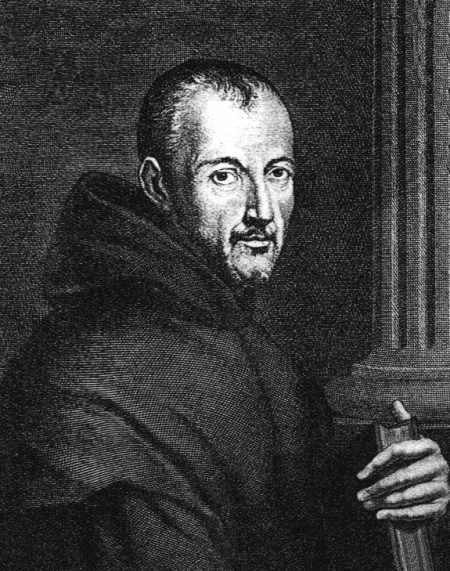 |
| Mersenne (1588-1648) |
 |
| Pythagoras 570-495 B.C.E. |
RE Music, Harmony, Pythagoras: "Philosophers since the time of Pythagoras had dreamed of discovering a natural harmony in the universe that would be expressed in mathematical terms. This suggested that, if one could crack the cosmological code and then express it in musical notation, one could use music to help bring the human soul into harmony with the universe...One sees remnants of that tradition in some of Descartes' contemporaries, such as Keplar's Harmony of the World (1619) and MErsenne's Universal Harmony (1636)" 43
 |
| Apotheosis of St Thomas Acquinas. Francisco de Zurbaran, 1631 |
RE Scholastic Philosophy: "For some decades scholastic philosophy had seemd to many scholars to be 'dead, barren, outworn, and irrelevant.' The response to this widespread intellectual effeteness emerged in two forms, religious and philosophical. The religious response was the familiar challenge of the Reformation to return to a form of Christianity that was closer to the Gospel, and to unshackle the church from the debilitating scholasticism that it had adopted as its official language. / THe philosophical response was an equally radical search for new categories and new sciences that would put its practitioners in touch with a wide range of natural forces and, through them, with the ultimate source of these occult powers, God." 54
RE Arcanum, mysticism: "He wrote to Mersenne, 20 November 1629: 'As soon as I even see the word arcanum [secret] in a proposition, I begin to think poorly of it" 58

No comments:
Post a Comment